
There is a moment in the 1985 Italian horror movie Demons when a character looks into a mirror, notices a wound, her body distorts, her actions become violent, and whatever distance once existed between perception and rational response disappears.

What we are seeing here does not imply horror. It is a problem of too much. For Slavoj Zizek, this ‘too much’ is central to how the subject is structured. Zizek draws upon Lacanian psychoanalysis to argue that our sense of self depends on a symbolic order – language, meaning, and shared structures that allow us to interpret experience. We function as long as what we encounter can be contained within the frameworks.
But sometimes, something exceeds them.
Zizek calls this excess jouissance: an intensity that is not merely pleasurable, but overwhelming. Something that disrupts meaning and resists being contained. It is what happens when experience can no longer be integrated by the systems that usually organise it. Demons can be read as a sustained staging of this condition.
When the Frame Breaks.
Setting most of the movie in a cinema provides a clear staging point. It is a controlled environment; spectators sit, watch, and interpret images projected on the screen. Horror, in this context, is contained on the screen. While we might see and hear the horror on the screen, the viewer does not become the horror. That is, when watching a horror movie, horror belongs to the film, not the viewer.

This distinction begins to break down as the audience watching the in-movie film continues.
As the narrative progresses, characters hear screams and struggle to determine whether they are part of the film or coming from behind the screen. One insists the screams are ‘real.’ But by this point, the distinction has already collapsed; some members of the audience are becoming the horror itself. The symbolic frame, fiction vs reality, no longer holds.
This is a classic Zizek moment. The system that organises experience breaks down, and what emerges is confusion, urgency, and escalation.
The Eruption of Excess.
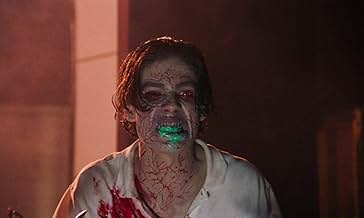
The transformation scenes extend this breakdown to the body. The first character ‘infected’ Carmen, has the following progression:
- First, an initial wound from a mysterious mask.
- Second, increasing distress.
- Third, visible bodily changes
- Finally, a sudden, violent aggression toward others
This sequence is the moment when Zizek’s idea of jouissance can be seen to overtake the subject. The body is no longer regulated by rational meaning or interpretation. Instead, it becomes the site where excess manifests directly.
What had been contained, Carmen’s fear, anxiety, intensity, has now appeared externally, in distorted nails, teeth, eyes and facial structure. Behaviour follows immediately. There is no pause, no deliberation, no rationalisation.
The subject does not respond rationally to the situation. It is overtaken by it.
Making Excess More Precise.
Zizek’s idea of jouissance is useful, but can be a little abstract. It tells us what this breakdown is like, but not how it unfolds.
To make this more precise, we can turn briefly to Bruno Cayoun’s Mindfulness-Integrated Cognitive Behavioural Therapy (MiCBT), used here not as a clinic method, but as a useful way to understand the embodied model of how experience is processed.
In this model, each moment unfolds through a rapid loop:
situation > perception > evaluation > body sensation > reaction.
A key point is that body sensations are the immediate drivers of emotional response, and that the intensity of these sensations determines how likely we are to react.
What Zizek calls jouissance can, in this regard, be understood more concretely as the point at which bodily sensation becomes so intense that reaction becomes unavoidable.
Re-reading Transformation.
Returning to Carmen’s scene with this in mind, the sequence becomes more understandable. The mask and the wound it causes are not just a narrative device. Receiving the wound marks a site of heightened, localised sensation of pain, agitation and disturbance. At the same time, the environment produces sensory overload. We have the collapsing boundary between film and reality, the screams, the visual chaos and transformation. These elements feed into rapid evaluation: something is wrong, something is very dangerous. This evaluation amplified bodily intensity further as bodies become assaulted and transformed.
What follows is not random and arbitrary. It is a threshold being crossed.
The grotesque physical changes of nails into claws, teeth into fangs, and faces distorting into demons can be read as a cinematic externalisation of what is normally internal. The escalating, unregulated body sensation. Once this intensity reaches a certain point, behaviour shifts to an immediate, violent reaction.
The ‘demon’, in this sense, is not simply an invader. It is what the system looks like when it can no longer regulate itself.
Action Without Distance.
The character of George complicates this picture. He survives longer than most and demonstrates effective, coordinated action. He helps organise the escape attempts, he effectively fights off the demons, and navigates the claustrophobic, hostile environment.
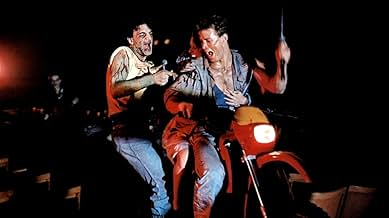
But this effectiveness does not necessarily indicate control of reduced reactivity. His behaviour remains urgent, intense, and driven. Rather than an example of control, it may represent organised reactivity. Channelling the intensity of the experience into structured action. Everything remains in disequilibrium. It is just more directed.
A World Without Interruption.
What is notably absent throughout Demons is any prolonged interruption to this loop. No character pauses to observe and try to understand why this is happening. The result is a closed system in which the intensity keeps escalating unchecked, and reactions become increasingly frantic and desperate.
Clarifying Jouissance.
Zizek is right to emphasise excess. Demons is saturated with it. It is the breakdown of meaning, the collapse of boundaries, the overwhelming of the subject.
What understanding this through an embodied model of affect adds is specificity.
Jouissance can be understood as a rapid, conditioned evaluation that generates escalating body sensations and culminates in an unavoidable reaction once a threshold is crossed. In this way, Demons presents a useful way of grounding Zizek’s idea of jouissance.
Conclusion.
Demons shows what happens when the gap between perception and reaction disappears. When the subject can no longer moderate what it experiences.
In Zizek’s terms, this is the eruption of jouissance.
In more concrete terms, it is what occurs when the intensity of bodily experience exceeds the system’s capacity to regulate it.
At that point, there is no longer a subject who chooses.
There is only the process running to its conclusion.
